Saqsayhuamán is one of the most impressive structures of the Inca Empire, located in Cusco, Peru. Here’s a detailed guide with information about its discovery, directions to get there, the geographic area, recent research, tourism, cultural activities, flora and fauna, and a detailed itinerary for your visit.

Saqsayhuamán, with its imposing architecture, has given rise to various legends that attempt to explain its construction and the mystery behind its enormous stones.
1. The Legend of the Giants
One of the most popular stories holds that Saqsayhuamán was built by giants. According to oral tradition, colossal beings helped the Incas move the enormous stones, some weighing more than 100 tons. These giants are said to have possessed supernatural strength and mysteriously disappeared after the fortress was completed.
2. The Legend of the Creator Gods
Another version suggests that the construction of Saqsayhuamán was guided by the Andean gods, who granted the Incas advanced knowledge to carve and assemble the stones with precision. It is believed that the god Viracocha, creator of the world, was the one who revealed the secrets of megalithic architecture.
3. The Legend of the Extraterrestrials
Some modern theories have fueled the idea that Saqsayhuamán could have been built with the help of beings from another planet. The perfection of the stonework and the lack of metal tools have led to speculation about advanced technology unknown at the time.
4. The Legend of the Inca and the Impossible Challenge
According to another story, an Inca challenged his architects to build a fortress that would withstand any attack. It is said that the builders, fearful of failure, worked day and night until they achieved a structure so perfect that not even a pin could pass between the stones.
These legends reflect the awe that Saqsayhuamán has generated over the centuries.
Summary
Discovery and History of Saqsayhuamán

Saqsayhuamán was built during the reign of Inca Pachacútec in the 15th century and completed by Huayna Cápac in the 16th century. It is believed that its purpose was both military and ceremonial, functioning as a fortress and a religious center dedicated to the Sun. Its zigzag design and massive stone walls have generated various theories about its function and significance.
Location and Geographic Area
Saqsayhuamán is located 2 km north of Cusco’s Plaza de Armas, at an altitude of 3,700 meters above sea level. Its area exceeds 3,000 hectares, surrounded by mountains and Andean landscapes. The area is home to a great diversity of flora and fauna, including llamas and falcons.
How to Get to Saqsayhuamán
There are several ways to get to Saqsayhuamán from Cusco:
– On foot: Approximately a 1-hour walk from downtown Cusco.
– By taxi: A 20-minute ride from the city.
– Public transportation: Some local bus lines arrive near the archaeological site.
– Organized tours: Several agencies offer guided tours with transportation included.
Latest Research
Recent research has revealed that Saqsayhuamán was not only a fortress, but also a ceremonial center with structures dedicated to sun worship. Remains of water channels and platforms have been found, suggesting an advanced Inca hydraulic system.
Important Tips for Visiting
– Altitude: Due to the altitude, it is advisable to acclimatize in Cusco before visiting.
– Appropriate Clothing: Bring comfortable clothing, sunscreen, and water.
– Entrance Fees: Included in the Partial Tourist Ticket (70 soles).
– Best time: Visit early in the morning to avoid crowds.
Characteristics of the Nearby Town
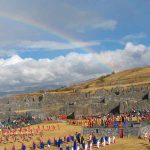
The town near Saqsayhuamán maintains many Andean traditions. In Cusco, festivals such as Inti Raymi, a reenactment of the ancient Inca ritual honoring the Sun, are celebrated. The local community also participates in artisanal and agricultural activities.
7. Tourism and Cultural Activities
Saqsayhuamán is a key tourist destination in Cusco. Some activities include:
– Guided tours to learn about the history and architecture of the site.
– Horseback riding in the surrounding area.
– Photography and observation of wildlife such as llamas and falcons.
– Cultural events, such as Inti Raymi.
Surrounding Flora and Fauna
The area around Saqsayhuamán is home to a wide variety of species:
– Flora: Ichu (Andean grass), queñua, molle.
– Fauna: Llamas, alpacas, falcons, condors.
Detailed Itinerary
Here is a suggested itinerary for a complete visit to Saqsayhuamán:
Morning
– 8:00 AM: Departure from Cusco.
– 8:30 AM: Arrival at Saqsayhuamán and acclimatization.
– 9:00 AM: Tour of the Cyclopean walls and historical explanation.
– 10:30 AM: Visit the towers and ceremonial platforms.
– 11:30 AM: Flora and fauna observation.
Afternoon
– 12:30 PM: Lunch in Cusco.
– 2:00 PM: Horseback ride in the surrounding area.
– 3:30 PM: Visit other nearby sites such as Q’enqo and Puka Pukara.
– 5:00 PM: Return to Cusco.
This content provides you with a comprehensive overview of Saqsayhuamán, ideal for your cultural promotion and tourism work.

Las Chincanas de Saqsayhuaman
The chincanas of Saqsayhuamán are underground tunnels that have been a subject of fascination and mystery for centuries. Recent research has confirmed the existence of a network of Inca tunnels connecting Saqsayhuamán with Coricancha, the ancient Temple of the Sun.
New Discoveries
– A main thoroughfare measuring 1,750 meters in length has been identified, with branches to Muyumarca and Callispuquio.
– Recent studies have used ground-penetrating radar and sonar surveying to map the structure of these tunnels.
– It has been confirmed that the chincanas not only had a ceremonial purpose, but could also have served for the transport of goods and strategic communication.
Historical Events in Saqsayhuamán
– Ancient chronicles mention the existence of these tunnels since the 16th century. Garcilaso de la Vega described them as “subterranean streets and avenues” that connected temples and fortresses.
– In the 19th century, journalist Ephraim Squier suggested that the entrance to the chincanas could be in an H-shaped temple located on the slopes of Saqsayhuamán.
– In January 2025, Cusco archaeologists confirmed the existence of this underground network, reinforcing the advanced engineering of the Inca Empire.
These findings expand our knowledge of Inca urban planning and their ability to integrate infrastructure with the Andean worldview.
Saqsayhuamán is one of the most impressive constructions of the Inca Empire, notable for its megalithic architecture and precise stone assembly. Here is detailed information about the materials used, the construction process, and the period in which it was built.
Materials Used at Saqsayhuamán
The Incas employed advanced techniques to work with large stones without mortar. The main materials were:
– Andesite and diorite: Volcanic rocks extracted from nearby quarries, such as Muyna and Rumicolca.
– Limestone: Used in some secondary structures.
– Stone and Copper Tools: Although the Incas did not have iron tools, they managed to carve and polish the stones with stone hammers and copper chisels.
How Saqsayhuamán Was Built
The construction of Saqsayhuamán is a testament to the Incas’ advanced architectural knowledge. It is estimated to have taken more than 70 years and required thousands of workers. Construction Process
– Stone extraction: Stones were transported from quarries several kilometers away.
– Carving and polishing: Each stone was precisely worked to fit perfectly without mortar.
– Transportation: Wooden rollers, ramps, and rope pulling techniques were used.
– Assembly: The stones were placed with such precision that it was impossible to insert a sheet of paper between them.

You might also like